BOXhaul
  • BOXhaul Dump Box
  • Accessories
    • Cart
    • Chain Door
    • Hinge Pin Door
    • Fork Pockets
    • Mesh Cover
    • Replacement Parts
  • Industries
    • Construction
    • Roofing
    • Demolition
    • Crane Rental
  • About
    • Partners
    • Areas We Serve
    • Careers
    • Blog
    • Specifications
  • Contact Us
  • Menu Menu

How a Dump Box Improves Jobsite Logistics Compared to Traditional Hauling

On busy commercial jobsites, logistics can make or break a project. Coordinating crews, crane schedules, debris removal, and material staging requires precision. When traditional construction trash hauling methods fall short, delays and congestion quickly ripple across the entire site.

A dump box offers a different approach. Instead of relying on repeated truck trips and manual handling, contractors can integrate debris removal directly into their lifting operations. The result is a more streamlined, controlled, and efficient workflow that supports productivity from day one.

The Logistical Challenges of Traditional Hauling

Traditional methods for hauling debris have long been part of commercial construction. Dumpsters, debris chutes, and third-party hauling services remain common. However, these approaches often introduce hidden inefficiencies that affect schedule, labor, and jobsite safety.

Multiple Trips and Scheduling Delays

When relying on construction trash hauling providers, debris removal typically depends on truck availability and traffic conditions. If dumpsters fill faster than expected, crews must wait for pickups before continuing demolition or tear-off work. These interruptions can stall progress and create idle time for skilled workers.

Repeated trips to haul off construction debris also increase overall site congestion. Trucks entering and exiting active jobsites compete with deliveries, equipment, and personnel, complicating coordination.

Labor Coordination and Downtime

Traditional hauling often requires additional labor to move debris from elevated surfaces to ground-level dumpsters. Workers may spend significant time pushing carts, managing chutes, or rehandling materials multiple times before final removal.

This fragmented process slows construction debris removal and diverts labor away from revenue-generating tasks. Instead of focusing on installation or structural work, crews become occupied with waste management logistics.

Congestion and Site Clutter

Overflowing dumpsters and staging areas filled with commercial waste can quickly create unsafe conditions. Piles of debris obstruct walkways, block access points, and increase trip hazards. In high-traffic environments, poor debris management undermines jobsite safety and reduces overall efficiency.

Traditional hauling methods often treat debris removal as a separate phase rather than an integrated part of daily workflow. That separation creates avoidable friction on active projects.

How a Dump Box Streamlines Construction Debris Removal

A dump box changes how debris moves through the jobsite. Instead of waiting for ground-level pickups, contractors can lift debris directly from the work area using existing crane operations. This integration transforms construction debris removal into a coordinated part of material handling rather than a reactive cleanup task.

Because a dump box attaches directly to a crane, it allows high-capacity loads to be transported quickly and efficiently. Crews load debris at elevation, and the crane lowers it to designated disposal areas in controlled cycles. This eliminates the need for excessive manual rehandling and reduces reliance on outside hauling schedules.

The self-dumping design of a modern crane dump box further accelerates the process. Once lowered, the box can be emptied quickly and reset for the next load. That repeatable, predictable cycle supports consistent workflow and reduces downtime throughout the day.

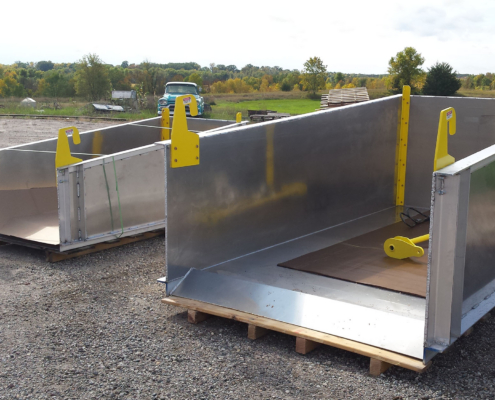
 Looking for ways to improve debris handling? Explore BOXHaul’s dump box solutions to see how crane-attached systems improve efficiency and simplify high-volume removal. 

Our Dump Box Solutions

Reducing Disruptions on Busy and High-Traffic Sites

On large commercial projects, especially in urban or occupied environments, minimizing disruption is critical. A dump box helps contractors maintain tighter control over debris movement without relying on frequent truck traffic.

Busy sites benefit from:

  • Reduced truck congestion during peak work hours
  • Fewer interruptions to pedestrian pathways
  • Controlled lift schedules that align with crane operations
  • Less ground-level clutter from overflowing containers
  • Improved separation between active work zones and disposal areas

A well-planned dump box strategy also supports better coordination between trades. When debris removal is predictable and scheduled around core activities, overall jobsite logistics improve significantly.

Improved Crew Efficiency With On-Demand Debris Handling

Efficiency on a commercial project depends on maintaining continuous workflow. When debris accumulates faster than it can be removed, productivity slows. A dump box allows crews to manage waste on demand rather than waiting for outside hauling services.

Continuous Workflow

With a crane-integrated system, debris removal becomes part of the regular lift cycle. Crews can load materials into the dump box as they work, knowing that removal will occur quickly and reliably. This reduces downtime and keeps installation or demolition activities moving forward.

Continuous debris handling also supports better housekeeping. Clean work areas contribute to jobsite safety and reduce the likelihood of accidents caused by cluttered surfaces.

Faster Cycles With a Crane Dump Box

A crane dump box is designed for high-capacity loads and efficient dumping. Because it leverages equipment already on site, contractors eliminate redundant movement. Each lift accomplishes more, reducing the total number of cycles needed to manage waste.

Compared to traditional methods that require trucks to haul off construction debris repeatedly, crane-based systems centralize and simplify the process.

Less Manual Rehandling

Manual rehandling is one of the biggest inefficiencies in traditional construction trash hauling. Debris is often moved from roof to chute, from chute to cart, and from cart to dumpster. Each transfer consumes time and increases risk.

A dump box reduces these touchpoints. By moving debris in larger, consolidated loads, contractors cut down on unnecessary labor and streamline construction debris removal operations.

Flexibility in Placement and Usage

One of the most significant advantages of a dump box is its flexibility. Unlike fixed dumpsters or stationary chutes, crane-attached systems can be positioned strategically based on project needs.

This flexibility supports a variety of logistical scenarios:

  • Rooftop Loading for Elevated Work: Roofing and high-rise projects benefit from direct loading at elevation. Debris can be placed immediately into the dump box without intermediate handling.
  • Ground-Level Coordination: On demolition sites, the box can be positioned to receive debris from multiple work areas, centralizing disposal.
  • Adaptability for Phased Construction: As projects progress through phases, the dump box can be relocated to align with changing work zones.
  • Support for Different Debris Types: From lightweight materials to heavier commercial construction debris, the right configuration accommodates varying load profiles.

This adaptability enhances overall construction debris removal planning and reduces the need to redesign staging areas mid-project.

Ideal Projects for a Dump Box Solution

Not every project has the same debris profile, but many commercial jobs benefit significantly from crane-based systems. A dump box is particularly effective for projects that generate high volumes of waste in concentrated periods.

Roofing tear-offs often require rapid debris removal to maintain productivity and protect exposed areas. Phased demolition projects benefit from predictable removal cycles that align with structural sequencing. Large commercial builds with limited laydown space gain efficiency by reducing reliance on multiple dumpsters.

In these environments, traditional construction trash hauling may struggle to keep pace. A dump box offers a scalable solution that aligns with crane operations and supports efficient material flow.

Improve Your Jobsite Logistics With the Right Dump Box Strategy

Jobsite logistics depend on how efficiently materials move in and out of the work area. A well-planned dump box solution integrates debris handling directly into your lifting operations, reducing clutter and improving coordination.

BOXHaul’s innovative dump box systems are engineered to improve jobsite safety, increase efficiency, and provide reliable support for demanding commercial builds. Reach out today to learn how the right equipment strategy can elevate your entire jobsite operation.

Share This Post

  • Share on Facebook
  • Share on X
  • Share on WhatsApp
  • Share on Pinterest
  • Share on LinkedIn
  • Share on Tumblr
  • Share on Vk
  • Share on Reddit
  • Share by Mail

More Like This

BoxHaul Dump Box - dump box back

Concrete & Heavy Debris Dump Boxes: What Contractors Need to Know

Construction Dump Boxes
https://boxhaul.com/wp-content/uploads/2026/03/BoxHaul-Dump-Box-dump-box-back.jpg 1250 2000 Abstrakt Marketing /wp-content/uploads/2023/10/BOXhaul_Logo.png Abstrakt Marketing2026-05-18 10:04:192026-05-18 10:04:27Concrete & Heavy Debris Dump Boxes: What Contractors Need to Know

Construction Dumpster Sizes Explained: Choosing the Right Dump Box for Each Phase of a Build

Construction Dump Boxes
https://boxhaul.com/wp-content/uploads/2026/05/Choosing-the-Right-Dump-Box-for-Each-Phase-of-a-Build.jpg 1250 2000 Abstrakt Marketing /wp-content/uploads/2023/10/BOXhaul_Logo.png Abstrakt Marketing2026-05-18 09:26:462026-05-18 09:26:56Construction Dumpster Sizes Explained: Choosing the Right Dump Box for Each Phase of a Build
BoxHaul Dump Box - dump boxes sitting in driveway

How to Scale Dump Box Rentals Across Multiple Construction Sites

Construction Dump Boxes
https://boxhaul.com/wp-content/uploads/2026/03/BoxHaul-Dump-Box-dump-boxes-sitting-in-driveway.jpg 1250 2000 Abstrakt Marketing /wp-content/uploads/2023/10/BOXhaul_Logo.png Abstrakt Marketing2026-05-18 09:20:292026-05-18 09:21:13How to Scale Dump Box Rentals Across Multiple Construction Sites
BoxHaul Dump Box - side view of two dump boxes

From Punch List to Handoff: Cleanup Strategies for Project Closeout

Construction Dump Boxes
https://boxhaul.com/wp-content/uploads/2026/03/BoxHaul-Dump-Box-side-view-of-two-dump-boxes.jpg 1250 2000 Abstrakt Marketing /wp-content/uploads/2023/10/BOXhaul_Logo.png Abstrakt Marketing2026-04-03 18:04:522026-05-17 15:56:02From Punch List to Handoff: Cleanup Strategies for Project Closeout
boxhaul forklift dump box view from below

How Construction Teams Use the BOXhaul On-Site Dumpster to Fill Gaps

Construction Dump Boxes
https://boxhaul.com/wp-content/uploads/2023/10/20230921_104202.jpg 1250 2000 Abstrakt Marketing /wp-content/uploads/2023/10/BOXhaul_Logo.png Abstrakt Marketing2026-04-03 18:01:262026-05-17 15:56:02How Construction Teams Use the BOXhaul On-Site Dumpster to Fill Gaps
boxhaul senior dump box view 2

Why Flexibility Matters in Construction Debris Removal Processes

Construction Dump Boxes
https://boxhaul.com/wp-content/uploads/2023/10/2014-09-23-09.15.19.jpg 1250 2000 Abstrakt Marketing /wp-content/uploads/2023/10/BOXhaul_Logo.png Abstrakt Marketing2026-04-03 17:57:242026-05-17 15:56:02Why Flexibility Matters in Construction Debris Removal Processes
boxhaul dump box in factory photo

How BOXhaul Improves the Debris Removal Workflow

Construction Dump Boxes
https://boxhaul.com/wp-content/uploads/2023/10/A0467_BOXHAUL_120_OLV_SEPT19_LOGO.00_01_00_04.Still006.jpg 1080 1920 Abstrakt Marketing /wp-content/uploads/2023/10/BOXhaul_Logo.png Abstrakt Marketing2026-04-03 17:52:492026-05-17 15:56:02How BOXhaul Improves the Debris Removal Workflow

How to Plan Construction Debris Removal Before a Big Project Starts

Construction Dump Boxes
https://boxhaul.com/wp-content/uploads/2026/03/How-to-Plan-Construction-Debris-Removal-Before-a-Big-Project-Starts.jpg 1250 2000 Abstrakt Marketing /wp-content/uploads/2023/10/BOXhaul_Logo.png Abstrakt Marketing2026-03-23 16:52:452026-05-17 15:56:03How to Plan Construction Debris Removal Before a Big Project Starts
boxhaul dump box being hoisted in air with crane hinge / cables

Debris Dump Boxes vs. Traditional Debris Handling

Debris Dump Box
https://boxhaul.com/wp-content/uploads/2023/10/2011-09-16-13.24.06-1.jpg 1250 2000 Abstrakt Marketing /wp-content/uploads/2023/10/BOXhaul_Logo.png Abstrakt Marketing2026-03-23 16:43:382026-05-17 15:56:03Debris Dump Boxes vs. Traditional Debris Handling
Previous Previous Previous Next Next Next

Categories

  • Attachments
  • Boxhaul
  • Construction Dump Boxes
  • Construction Logistics
  • Construction Site Operations
  • Construction Waste Management
  • Debris Dump Box
  • Demolition Dump Boxes
  • Dump Box Safety
  • Equipment Maintenance
  • Equipment Use
  • Material Handling
  • Roofing
  • Safety
  • Self Dumper Boxes
  • Site Operations
  • Uncategorized

Contact Us

"*" indicates required fields

This field is for validation purposes and should be left unchanged.

About Us

BOXhaul’s one-of-a-kind dump boxes are revolutionizing how commercial construction gets done.

What We Do

The BOXhaul Dump Box

BOXhaul Accessories 

Industries We Serve

About Us

Contact Us

9363 67th Street NW, Annandale, MN 55302

(612) 702-5392

sales@boxhaul.com

Website by Abstrakt Marketing Group ©
  • Privacy Policy
  • Sitemap
  • Linkedin
  • Facebook
Scroll to top Scroll to top Scroll to top

This site uses cookies. By continuing to browse the site, you are agreeing to our use of cookies.

AcceptLearn more

Cookie and Privacy Settings


How we use cookies

We may request cookies to be set on your device. We use cookies to let us know when you visit our websites, how you interact with us, to enrich your user experience, and to customize your relationship with our website.

Click on the different category headings to find out more. You can also change some of your preferences. Note that blocking some types of cookies may impact your experience on our websites and the services we are able to offer.

Essential Website Cookies

These cookies are strictly necessary to provide you with services available through our website and to use some of its features.

Because these cookies are strictly necessary to deliver the website, refusing them will have impact how our site functions. You always can block or delete cookies by changing your browser settings and force blocking all cookies on this website. But this will always prompt you to accept/refuse cookies when revisiting our site.

We fully respect if you want to refuse cookies but to avoid asking you again and again kindly allow us to store a cookie for that. You are free to opt out any time or opt in for other cookies to get a better experience. If you refuse cookies we will remove all set cookies in our domain.

We provide you with a list of stored cookies on your computer in our domain so you can check what we stored. Due to security reasons we are not able to show or modify cookies from other domains. You can check these in your browser security settings.

Other external services

We also use different external services like Google Webfonts, Google Maps, and external Video providers. Since these providers may collect personal data like your IP address we allow you to block them here. Please be aware that this might heavily reduce the functionality and appearance of our site. Changes will take effect once you reload the page.

Google Webfont Settings:

Google Map Settings:

Google reCaptcha Settings:

Vimeo and Youtube video embeds:

Accept settingsHide notification only