BOXhaul
  • BOXhaul Dump Box
  • Accessories
    • Cart
    • Chain Door
    • Hinge Pin Door
    • Fork Pockets
    • Mesh Cover
    • Replacement Parts
  • Industries
    • Construction
    • Roofing
    • Demolition
    • Crane Rental
  • About
    • Partners
    • Areas We Serve
    • Careers
    • Blog
    • Specifications
  • Contact Us
  • Menu Menu

Concrete & Heavy Debris Dump Boxes: What Contractors Need to Know

Concrete is one of the most common materials on a commercial construction site — and one of the most problematic to remove. A single cubic yard of concrete weighs roughly 4,000 pounds. Brick, asphalt, and stone aren’t far behind. For contractors managing demolition, renovation, or site clearing, heavy debris isn’t a niche challenge. It’s a daily operational reality.

The problem is that most standard roll-off containers aren’t built with heavy debris in mind. They’re sized and rated for general waste: mixed construction materials, packaging, light demo waste. Drop a partial concrete pour or a brick tear-off into a standard dumpster and you’re looking at overweight fees, equipment strain, or both.

Choosing the right heavy debris dumpster requires understanding how weight (not volume) drives every decision in concrete disposal and dense material handling. This guide breaks down what contractors need to know before the debris starts moving.

Weight Changes Everything About Heavy Debris Handling

The instinct on most jobsites is to think about dumpster sizing in terms of volume: cubic yards, how much fits, how many trips. For general construction debris, that mental model works reasonably well. For heavy debris, it leads to consistent, expensive mistakes.

Concrete, asphalt, brick, and stone reach weight capacity long before they reach volume capacity. A dump box rated for a certain payload can be less than half full visually and already at its maximum safe load when filled with dense material. Continuing to load past that threshold creates problems that compound quickly:

  • Overweight fees: from disposal facilities, which can be significant and aren’t always predictable
  • Equipment strain: on cranes and forklifts handling loads they weren’t rated for
  • Safety risks: from unstable lifts and overstressed lifting hardware
  • Regulatory exposure: if transport weight limits are exceeded

The operational rule for heavy debris is simple: size your container for weight, not volume. What that means in practice is choosing a smaller, lower-profile dump box rated for high-density loads rather than a large container that looks right but performs wrong.

What Makes a Dump Box Right for Concrete and Heavy Debris

Not every dump box handles heavy debris equally well. Several design factors determine whether a container is actually suited for concrete disposal, asphalt removal, or masonry work—or whether it just looks like it could be.

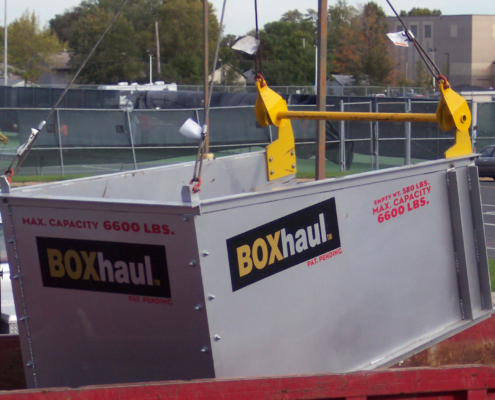
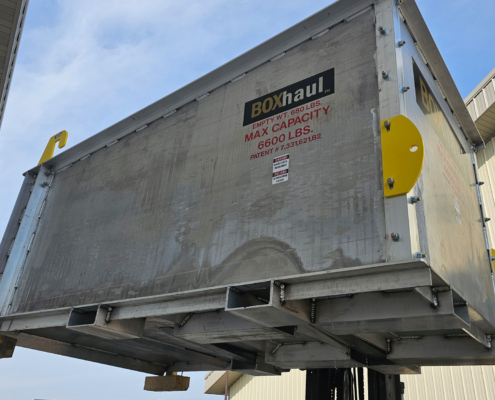
  • Payload rating: The most important number. BOXhaul dump boxes are rated to handle loads up to 6,600 pounds, making them viable for dense debris that standard containers can’t accommodate safely. Verify this number before committing equipment to a heavy debris application.
  • Low center of gravity: Dense materials shift the center of gravity lower and forward as the box fills. A well-engineered container accounts for this in its structural design, keeping lifts stable and predictable even with full loads of heavy material.
  • Crane and forklift compatibility: Heavy debris sites almost always involve crane operations or extended-reach forklifts. A dump box that integrates cleanly with your existing lifting equipment keeps operations moving and reduces the coordination overhead that slows heavy demo work down.
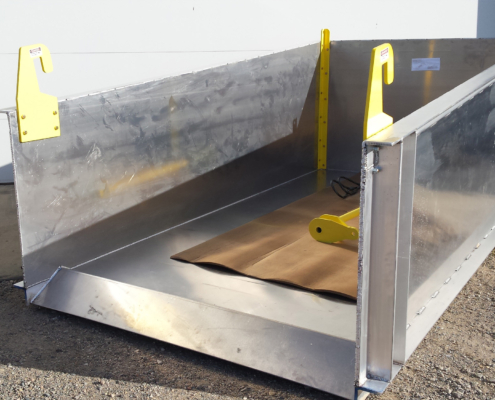
  • Gravity-based self-dumping: Hydraulic dumping systems add mechanical complexity and failure points. For heavy debris, a gravity-based self-dumping design means the box empties reliably with every lift.

Clean Load vs. Mixed Load: Why It Matters for Concrete Disposal

One distinction that affects both cost and logistics in heavy debris handling is the difference between clean load and mixed load disposal.

A clean load concrete dumpster contains only one material: concrete, in this case. Clean loads are significantly easier and cheaper to dispose of. Concrete recycling facilities accept clean loads at lower rates than general construction waste, and some will pick up at no cost if the volume justifies it. Clean concrete can be crushed and recycled into base material, road fill, or aggregate—keeping it out of the landfill entirely.

A mixed load combines concrete with other materials—wood, metal, packaging, general debris. Mixed loads are harder to recycle, command higher disposal rates, and limit your options for sustainable waste management.

For contractors serious about cost control on concrete-heavy projects, the operational discipline of keeping loads clean pays off consistently. It requires more intentional staging —designating specific dump boxes for concrete versus general debris— but the savings on disposal fees typically justify the coordination.

BOXhaul’s customizable sizing and multi-box configurations make it practical to dedicate separate containers to heavy material streams without disrupting overall site workflow.

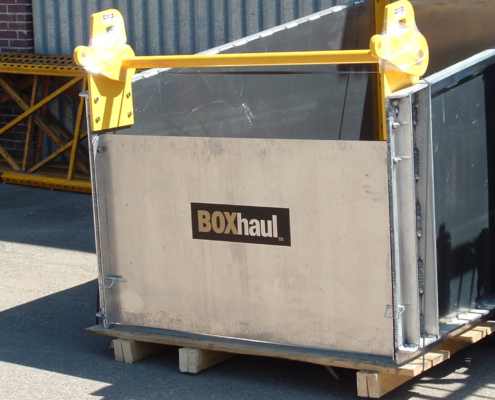
Managing heavy debris on an upcoming project? BOXhaul dump boxes are rated for up to 6,600 lbs and built to work with your existing cranes and forklifts no hydraulics, no special attachments.

Get a Quote

Sizing a Heavy Debris Dumpster: Phase-by-Phase Considerations

Heavy debris shows up at different concentrations depending on where you are in the project. Sizing appropriately for each phase protects both your equipment and your budget.

Demolition and Concrete Removal

This is peak heavy debris volume. Structural concrete, footings, slabs, and masonry all concentrate at the demo phase. The priority here is cycling capacity efficiently: containers that can be filled, lifted, emptied, and returned quickly keep the demo crew moving without interruption.

For concrete removal specifically, prioritize clean load discipline from the first day of demo. The cost difference between clean concrete disposal and mixed load disposal adds up significantly over a full demolition project.

Site Clearing and Grading

Asphalt removal and soil with embedded stone or rubble generates heavy debris at high volume. Many contractors underestimate the weight load of asphalt tear-off in particular: it’s denser than it looks and fills weight limits before volume limits on standard containers.

A lower-capacity container cycled frequently outperforms a large container loaded past its rating. Plan your dump box scheduling around weight thresholds, not visual fill levels.

Structural Work and Foundation Pours

Residual concrete from pours: waste concrete, form spillage, and cleanup material: accumulates throughout structural work. This material is often overlooked in debris planning because it comes in smaller quantities, but it’s still heavy and still needs to be handled correctly.

Designate a dedicated container for concrete waste during structural phases, separate from general construction debris. It’s a simple operational discipline that makes disposal faster and cheaper.

Common Mistakes That Lead to Overweight Fees

Contractors who work with heavy debris regularly develop a feel for what different materials weigh. Those who don’t end up learning through overweight charges. The most common mistakes:

  • Filling by sight, not by weight: A box that looks half full of concrete is often at or near its weight limit. Train crews to stop loading based on weight estimates, not visual fill level.
  • Mixing heavy and light debris: Mixed loads get charged at general waste rates and can’t be recycled efficiently. The cost differential over a project is real.
  • Using the wrong container for the application: A high-volume dumpster rated for light debris isn’t a substitute for a purpose-rated heavy debris container, even if the dimensions look similar. Ratings exist for a reason.
  • Not accounting for moisture: Concrete, soil, and masonry absorb water. A container loaded with material after rain can be significantly heavier than the same material loaded dry. Account for this in wet weather scheduling.

Handle Heavy Debris Right From the Start

Concrete disposal and dense material handling aren’t problems you want to solve reactively. Overweight fees, equipment strain, and disposal complications are all avoidable — but only if you make the right equipment decisions before debris starts accumulating.

BOXhaul dump boxes are built to handle the weight demands of heavy commercial debris, with payload ratings, crane compatibility, and clean-load configurations that keep operations efficient from demolition through final cleanout.

Contact the BOXhaul team to discuss your project’s debris profile and find the right configuration for your next build.

Share This Post

  • Share on Facebook
  • Share on X
  • Share on WhatsApp
  • Share on Pinterest
  • Share on LinkedIn
  • Share on Tumblr
  • Share on Vk
  • Share on Reddit
  • Share by Mail

More Like This

Excavator bucket loading debris into a dump truck

Construction Dumpster Rental Alternatives: Custom Dump Boxes

Boxhaul, Construction Dump Boxes
https://boxhaul.com/wp-content/uploads/2026/06/Excavator-bucket-loading-debris-into-a-dump-truck.jpg 1250 2000 Abstrakt Marketing /wp-content/uploads/2023/10/BOXhaul_Logo.png Abstrakt Marketing2026-06-09 08:11:272026-06-09 08:11:34Construction Dumpster Rental Alternatives: Custom Dump Boxes

Construction Dumpster Sizes Explained: Choosing the Right Dump Box for Each Phase of a Build

Construction Dump Boxes
https://boxhaul.com/wp-content/uploads/2026/05/Choosing-the-Right-Dump-Box-for-Each-Phase-of-a-Build.jpg 1250 2000 Abstrakt Marketing /wp-content/uploads/2023/10/BOXhaul_Logo.png Abstrakt Marketing2026-05-18 09:26:462026-05-18 09:26:56Construction Dumpster Sizes Explained: Choosing the Right Dump Box for Each Phase of a Build
BoxHaul Dump Box - dump boxes sitting in driveway

How to Scale Dump Box Rentals Across Multiple Construction Sites

Construction Dump Boxes
https://boxhaul.com/wp-content/uploads/2026/03/BoxHaul-Dump-Box-dump-boxes-sitting-in-driveway.jpg 1250 2000 Abstrakt Marketing /wp-content/uploads/2023/10/BOXhaul_Logo.png Abstrakt Marketing2026-05-18 09:20:292026-05-18 09:21:13How to Scale Dump Box Rentals Across Multiple Construction Sites
BoxHaul Dump Box - side view of two dump boxes

From Punch List to Handoff: Cleanup Strategies for Project Closeout

Construction Dump Boxes
https://boxhaul.com/wp-content/uploads/2026/03/BoxHaul-Dump-Box-side-view-of-two-dump-boxes.jpg 1250 2000 Abstrakt Marketing /wp-content/uploads/2023/10/BOXhaul_Logo.png Abstrakt Marketing2026-04-03 18:04:522026-05-17 15:56:02From Punch List to Handoff: Cleanup Strategies for Project Closeout
boxhaul forklift dump box view from below

How Construction Teams Use the BOXhaul On-Site Dumpster to Fill Gaps

Construction Dump Boxes
https://boxhaul.com/wp-content/uploads/2023/10/20230921_104202.jpg 1250 2000 Abstrakt Marketing /wp-content/uploads/2023/10/BOXhaul_Logo.png Abstrakt Marketing2026-04-03 18:01:262026-05-17 15:56:02How Construction Teams Use the BOXhaul On-Site Dumpster to Fill Gaps
boxhaul senior dump box view 2

Why Flexibility Matters in Construction Debris Removal Processes

Construction Dump Boxes
https://boxhaul.com/wp-content/uploads/2023/10/2014-09-23-09.15.19.jpg 1250 2000 Abstrakt Marketing /wp-content/uploads/2023/10/BOXhaul_Logo.png Abstrakt Marketing2026-04-03 17:57:242026-05-17 15:56:02Why Flexibility Matters in Construction Debris Removal Processes
boxhaul dump box in factory photo

How BOXhaul Improves the Debris Removal Workflow

Construction Dump Boxes
https://boxhaul.com/wp-content/uploads/2023/10/A0467_BOXHAUL_120_OLV_SEPT19_LOGO.00_01_00_04.Still006.jpg 1080 1920 Abstrakt Marketing /wp-content/uploads/2023/10/BOXhaul_Logo.png Abstrakt Marketing2026-04-03 17:52:492026-05-17 15:56:02How BOXhaul Improves the Debris Removal Workflow
crane attached dump box being cleared by a man on heavy equipment

How a Dump Box Improves Jobsite Logistics Compared to Traditional Hauling

Construction Dump Boxes, Debris Dump Box, Demolition Dump Boxes
https://boxhaul.com/wp-content/uploads/2023/10/074.jpg 1250 2000 Abstrakt Marketing /wp-content/uploads/2023/10/BOXhaul_Logo.png Abstrakt Marketing2026-03-29 22:23:522026-05-17 15:56:02How a Dump Box Improves Jobsite Logistics Compared to Traditional Hauling

How to Plan Construction Debris Removal Before a Big Project Starts

Construction Dump Boxes
https://boxhaul.com/wp-content/uploads/2026/03/How-to-Plan-Construction-Debris-Removal-Before-a-Big-Project-Starts.jpg 1250 2000 Abstrakt Marketing /wp-content/uploads/2023/10/BOXhaul_Logo.png Abstrakt Marketing2026-03-23 16:52:452026-05-17 15:56:03How to Plan Construction Debris Removal Before a Big Project Starts
Previous Previous Previous Next Next Next

Categories

  • Attachments
  • Boxhaul
  • Construction Dump Boxes
  • Construction Logistics
  • Construction Site Operations
  • Construction Waste Management
  • Debris Dump Box
  • Demolition Dump Boxes
  • Dump Box Safety
  • Equipment Maintenance
  • Equipment Use
  • Material Handling
  • Roofing
  • Safety
  • Self Dumper Boxes
  • Site Operations
  • Uncategorized

Contact Us

"*" indicates required fields

This field is for validation purposes and should be left unchanged.

About Us

BOXhaul’s one-of-a-kind dump boxes are revolutionizing how commercial construction gets done.

What We Do

The BOXhaul Dump Box

BOXhaul Accessories 

Industries We Serve

About Us

Contact Us

9363 67th Street NW, Annandale, MN 55302

(612) 702-5392

sales@boxhaul.com

Website by Abstrakt Marketing Group ©
  • Privacy Policy
  • Sitemap
  • Linkedin
  • Facebook
Scroll to top Scroll to top Scroll to top

This site uses cookies. By continuing to browse the site, you are agreeing to our use of cookies.

AcceptLearn more

Cookie and Privacy Settings


How we use cookies

We may request cookies to be set on your device. We use cookies to let us know when you visit our websites, how you interact with us, to enrich your user experience, and to customize your relationship with our website.

Click on the different category headings to find out more. You can also change some of your preferences. Note that blocking some types of cookies may impact your experience on our websites and the services we are able to offer.

Essential Website Cookies

These cookies are strictly necessary to provide you with services available through our website and to use some of its features.

Because these cookies are strictly necessary to deliver the website, refusing them will have impact how our site functions. You always can block or delete cookies by changing your browser settings and force blocking all cookies on this website. But this will always prompt you to accept/refuse cookies when revisiting our site.

We fully respect if you want to refuse cookies but to avoid asking you again and again kindly allow us to store a cookie for that. You are free to opt out any time or opt in for other cookies to get a better experience. If you refuse cookies we will remove all set cookies in our domain.

We provide you with a list of stored cookies on your computer in our domain so you can check what we stored. Due to security reasons we are not able to show or modify cookies from other domains. You can check these in your browser security settings.

Other external services

We also use different external services like Google Webfonts, Google Maps, and external Video providers. Since these providers may collect personal data like your IP address we allow you to block them here. Please be aware that this might heavily reduce the functionality and appearance of our site. Changes will take effect once you reload the page.

Google Webfont Settings:

Google Map Settings:

Google reCaptcha Settings:

Vimeo and Youtube video embeds:

Accept settingsHide notification only