BOXhaul
  • BOXhaul Dump Box
  • Accessories
    • Cart
    • Chain Door
    • Hinge Pin Door
    • Fork Pockets
    • Mesh Cover
    • Replacement Parts
  • Industries
    • Construction
    • Roofing
    • Demolition
    • Crane Rental
  • About
    • Partners
    • Areas We Serve
    • Careers
    • Blog
    • Specifications
  • Contact Us
  • Menu Menu

Construction Dumpster Sizes Explained: Choosing the Right Dump Box for Each Phase of a Build

Not every phase of a construction project produces the same type or volume of debris. Demolition generates far more material than rough framing. Finish work creates a different kind of construction waste than site clearing. Yet many contractors approach dumpster selection the same way regardless of where they are in the build and they pay for it in crane time, crew efficiency, and unnecessary cost.

Choosing the right construction dumpster size isn’t just about capacity. It’s about matching your equipment to the work happening on site right now, so debris removal keeps pace with production instead of slowing it down.

This guide breaks down how dumpster size needs shift across the major phases of a commercial build and what contractors should look for when selecting roll-off dumpster sizes for each one.

Why Dumpster Size Matters More Than Most Contractors Realize

The instinct on most sites is to grab the biggest available dumpster and be done with it. Bigger box, fewer pickups, less coordination: in theory. In practice, oversizing and undersizing both create problems, just different ones.

An undersized box fills up before crews are ready to stop working. You’re coordinating an extra pickup mid-phase, interrupting crane schedules, and asking workers to hold debris instead of moving it. Productivity stalls while the logistics catch up.

An oversized box has its own cost. On a tight commercial site, a large roll-off occupies space that could be a staging area. If the box is filled with light materials, you’re paying for capacity you’ll never use. And on crane-dependent sites, lifting a heavy, oversized unit adds stress and time to every cycle.

The answer isn’t a universal size: it’s the right size for each phase.

Phase 1: Site Prep and Demolition

Demolition is the highest-volume debris phase of any build. Structural teardowns, concrete removal, old framing, and mixed commercial waste all generate material quickly and in bulk. This is the phase where undersizing a dump box costs the most.

For demolition work, contractors need maximum capacity paired with equipment that can cycle efficiently. A high-capacity dump box ensures that heavy, dense debris like concrete, masonry, and roofing material can be handled in fewer lifts.

What size construction dumpster for construction demolition phases? The general guidance is to prioritize capacity over everything else. On multi-story projects, crane-compatible dump boxes are especially valuable here because they allow debris to be collected at the floor level and emptied directly into a ground-level container. That eliminates the labor of manually hauling material down and keeps the crane doing productive work on both the lift and the dump.

The key spec to watch in demolition is weight rating, not volume. Dense material reaches weight limits before it fills the box. Verify your equipment can handle the heaviest loads you’ll encounter before the phase starts.

Phase 2: Rough Framing and Structural Work

Once demolition wraps and structural work begins, debris volume drops significantly but it doesn’t stop. Framing generates lumber offcuts, fasteners, packaging, and mixed light waste. Concrete pours produce lumber, plastic sheeting, and residual material.

At this phase, the question shifts from raw capacity to mobility and placement flexibility. Debris is generated across the full footprint of the site, often in multiple active zones simultaneously. A single large container in a fixed position may not be accessible from every work area—meaning workers carry material further than they should.

This is where customizable roll-off dumpster sizes show their value. A smaller, mobile dump box that can be repositioned by forklift or crane as work zones shift keeps debris collection close to the source. Multiple smaller boxes may outperform one large box at this phase, depending on site layout.

For contractors managing multiple zones, the right approach is matching box placement to where waste is actually being generated—not where it’s convenient for pickup.

Phase 3: MEP Rough-In (Mechanical, Electrical, Plumbing)

MEP phases generate lighter, lower-volume debris: conduit offcuts, pipe sections, wire scraps, packaging, and miscellaneous material. This is the lowest-intensity debris phase on most commercial projects.

Oversizing is the common mistake here. A contractor locked into a large roll-off from earlier phases continues paying for capacity they no longer need. For MEP rough-in, a compact dump box or a repositioned smaller unit serves the site better and at lower cost.

This is also a phase where site access becomes a constraint. MEP work often happens alongside other trades, and a large construction dumpster competes for the same limited staging space. Right-sizing at this phase protects site organization and reduces the friction between trades.

Phase 4: Interior Finishes and Drywall

Drywall, insulation, flooring materials, and finish carpentry all generate debris in moderate volumes, and the material profile shifts again. Finish debris is often lighter and bulkier than demolition or framing waste. A box that worked well for heavy concrete may be overkill for drywall offcuts and packaging.

For finish phases on commercial builds, the priority is frequency of removal rather than raw capacity. Light, bulky waste fills boxes quickly by volume even when weight is well below capacity. Scheduling regular pickups or deploying a dump box with efficient emptying cycles prevents overflow without requiring a large dedicated container.

BOXhaul’s self-dumping design works particularly well in interior finish environments. Because the box can be emptied on-site and returned to service without waiting for a pickup truck, debris removal cycles faster. Learn more below.

Explore the BOXhaul Dump Box

Phase 5: Final Cleanout and Punch List

Construction clean up is the final and often underplanned debris phase. By this point, most contractors have either over-removed equipment or are scrambling to clear residual waste before the owner walkthrough.

Final cleanout involves smaller volumes of mixed material: packaging, hardware remnants, scrap, and staging debris. The need here is typically a mid-size box that can be cycled once or twice to clear the site without committing to a full roll-off setup.

This is also the phase where site access is most restricted. Finished floors, installed fixtures, and tight access points limit where equipment can be positioned. A compact, crane- or forklift-compatible dump box can be positioned precisely and removed cleanly — without the footprint or logistics complexity of a traditional roll-off.

Choosing Across All Phases: The Case for Customizable Dump Box Sizing

The problem with standard roll-off dumpster sizes is that they’re designed around disposal logistics, not construction workflows. You get a limited set of fixed options, and you fit your project around them.

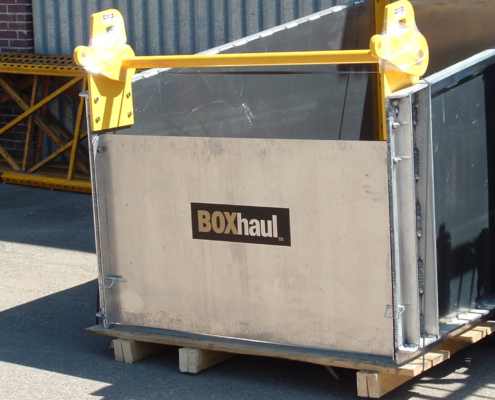
BOXhaul takes a different approach. Available in Junior, Standard, and Senior configurations, BOXhaul construction dump boxes are matched to the specific debris profile of each phase rather than forcing a one-size-fits-all solution. Because they work with your existing cranes and forklifts, they’re also repositionable as work zones evolve.

The result is a debris handling system that stays aligned with the project from demo through punch list, reducing unnecessary lifts, protecting crane schedules, and keeping crews focused on the work that moves the job forward.

Match Your Equipment to the Phase

Getting construction dumpster sizes right isn’t a one-time decision, it’s an ongoing one that should be revisited as the project progresses. The contractors who treat debris removal as a dynamic part of project planning rather than a fixed line item consistently outperform those who don’t.

If you’re planning an upcoming commercial build or managing a portfolio of active sites, contact the BOXhaul team to discuss how customizable dump box sizing can improve efficiency at every phase.

Share This Post

  • Share on Facebook
  • Share on X
  • Share on WhatsApp
  • Share on Pinterest
  • Share on LinkedIn
  • Share on Tumblr
  • Share on Vk
  • Share on Reddit
  • Share by Mail

More Like This

Excavator bucket loading debris into a dump truck

Construction Dumpster Rental Alternatives: Custom Dump Boxes

Boxhaul, Construction Dump Boxes
https://boxhaul.com/wp-content/uploads/2026/06/Excavator-bucket-loading-debris-into-a-dump-truck.jpg 1250 2000 Abstrakt Marketing /wp-content/uploads/2023/10/BOXhaul_Logo.png Abstrakt Marketing2026-06-09 08:11:272026-06-09 08:11:34Construction Dumpster Rental Alternatives: Custom Dump Boxes
BoxHaul Dump Box - dump box back

Concrete & Heavy Debris Dump Boxes: What Contractors Need to Know

Construction Dump Boxes
https://boxhaul.com/wp-content/uploads/2026/03/BoxHaul-Dump-Box-dump-box-back.jpg 1250 2000 Abstrakt Marketing /wp-content/uploads/2023/10/BOXhaul_Logo.png Abstrakt Marketing2026-05-18 10:04:192026-05-18 10:04:27Concrete & Heavy Debris Dump Boxes: What Contractors Need to Know
BoxHaul Dump Box - dump boxes sitting in driveway

How to Scale Dump Box Rentals Across Multiple Construction Sites

Construction Dump Boxes
https://boxhaul.com/wp-content/uploads/2026/03/BoxHaul-Dump-Box-dump-boxes-sitting-in-driveway.jpg 1250 2000 Abstrakt Marketing /wp-content/uploads/2023/10/BOXhaul_Logo.png Abstrakt Marketing2026-05-18 09:20:292026-05-18 09:21:13How to Scale Dump Box Rentals Across Multiple Construction Sites
BoxHaul Dump Box - side view of two dump boxes

From Punch List to Handoff: Cleanup Strategies for Project Closeout

Construction Dump Boxes
https://boxhaul.com/wp-content/uploads/2026/03/BoxHaul-Dump-Box-side-view-of-two-dump-boxes.jpg 1250 2000 Abstrakt Marketing /wp-content/uploads/2023/10/BOXhaul_Logo.png Abstrakt Marketing2026-04-03 18:04:522026-05-17 15:56:02From Punch List to Handoff: Cleanup Strategies for Project Closeout
boxhaul forklift dump box view from below

How Construction Teams Use the BOXhaul On-Site Dumpster to Fill Gaps

Construction Dump Boxes
https://boxhaul.com/wp-content/uploads/2023/10/20230921_104202.jpg 1250 2000 Abstrakt Marketing /wp-content/uploads/2023/10/BOXhaul_Logo.png Abstrakt Marketing2026-04-03 18:01:262026-05-17 15:56:02How Construction Teams Use the BOXhaul On-Site Dumpster to Fill Gaps
boxhaul senior dump box view 2

Why Flexibility Matters in Construction Debris Removal Processes

Construction Dump Boxes
https://boxhaul.com/wp-content/uploads/2023/10/2014-09-23-09.15.19.jpg 1250 2000 Abstrakt Marketing /wp-content/uploads/2023/10/BOXhaul_Logo.png Abstrakt Marketing2026-04-03 17:57:242026-05-17 15:56:02Why Flexibility Matters in Construction Debris Removal Processes
boxhaul dump box in factory photo

How BOXhaul Improves the Debris Removal Workflow

Construction Dump Boxes
https://boxhaul.com/wp-content/uploads/2023/10/A0467_BOXHAUL_120_OLV_SEPT19_LOGO.00_01_00_04.Still006.jpg 1080 1920 Abstrakt Marketing /wp-content/uploads/2023/10/BOXhaul_Logo.png Abstrakt Marketing2026-04-03 17:52:492026-05-17 15:56:02How BOXhaul Improves the Debris Removal Workflow
crane attached dump box being cleared by a man on heavy equipment

How a Dump Box Improves Jobsite Logistics Compared to Traditional Hauling

Construction Dump Boxes, Debris Dump Box, Demolition Dump Boxes
https://boxhaul.com/wp-content/uploads/2023/10/074.jpg 1250 2000 Abstrakt Marketing /wp-content/uploads/2023/10/BOXhaul_Logo.png Abstrakt Marketing2026-03-29 22:23:522026-05-17 15:56:02How a Dump Box Improves Jobsite Logistics Compared to Traditional Hauling

How to Plan Construction Debris Removal Before a Big Project Starts

Construction Dump Boxes
https://boxhaul.com/wp-content/uploads/2026/03/How-to-Plan-Construction-Debris-Removal-Before-a-Big-Project-Starts.jpg 1250 2000 Abstrakt Marketing /wp-content/uploads/2023/10/BOXhaul_Logo.png Abstrakt Marketing2026-03-23 16:52:452026-05-17 15:56:03How to Plan Construction Debris Removal Before a Big Project Starts
Previous Previous Previous Next Next Next

Categories

  • Attachments
  • Boxhaul
  • Construction Dump Boxes
  • Construction Logistics
  • Construction Site Operations
  • Construction Waste Management
  • Debris Dump Box
  • Demolition Dump Boxes
  • Dump Box Safety
  • Equipment Maintenance
  • Equipment Use
  • Material Handling
  • Roofing
  • Safety
  • Self Dumper Boxes
  • Site Operations
  • Uncategorized

Contact Us

"*" indicates required fields

This field is for validation purposes and should be left unchanged.

About Us

BOXhaul’s one-of-a-kind dump boxes are revolutionizing how commercial construction gets done.

What We Do

The BOXhaul Dump Box

BOXhaul Accessories 

Industries We Serve

About Us

Contact Us

9363 67th Street NW, Annandale, MN 55302

(612) 702-5392

sales@boxhaul.com

Website by Abstrakt Marketing Group ©
  • Privacy Policy
  • Sitemap
  • Linkedin
  • Facebook
Scroll to top Scroll to top Scroll to top

This site uses cookies. By continuing to browse the site, you are agreeing to our use of cookies.

AcceptLearn more

Cookie and Privacy Settings


How we use cookies

We may request cookies to be set on your device. We use cookies to let us know when you visit our websites, how you interact with us, to enrich your user experience, and to customize your relationship with our website.

Click on the different category headings to find out more. You can also change some of your preferences. Note that blocking some types of cookies may impact your experience on our websites and the services we are able to offer.

Essential Website Cookies

These cookies are strictly necessary to provide you with services available through our website and to use some of its features.

Because these cookies are strictly necessary to deliver the website, refusing them will have impact how our site functions. You always can block or delete cookies by changing your browser settings and force blocking all cookies on this website. But this will always prompt you to accept/refuse cookies when revisiting our site.

We fully respect if you want to refuse cookies but to avoid asking you again and again kindly allow us to store a cookie for that. You are free to opt out any time or opt in for other cookies to get a better experience. If you refuse cookies we will remove all set cookies in our domain.

We provide you with a list of stored cookies on your computer in our domain so you can check what we stored. Due to security reasons we are not able to show or modify cookies from other domains. You can check these in your browser security settings.

Other external services

We also use different external services like Google Webfonts, Google Maps, and external Video providers. Since these providers may collect personal data like your IP address we allow you to block them here. Please be aware that this might heavily reduce the functionality and appearance of our site. Changes will take effect once you reload the page.

Google Webfont Settings:

Google Map Settings:

Google reCaptcha Settings:

Vimeo and Youtube video embeds:

Accept settingsHide notification only