
BOXhaul
  • BOXhaul Dump Box
    • Specifications
  • Accessories
    • Cart
    • Chain Door
    • Hinge Pin Door
    • Fork Pockets
    • Mesh Cover
    • Replacement Parts
  • Industries
    • Construction
    • Roofing
    • Demolition
    • Crane Rental
  • About
    • Partners
    • Areas We Serve
    • Careers
    • Blog
    • Specifications
  • Contact Us
  • Menu Menu

How Crane Hoppers Work on Multi-Story Commercial Sites

A crane hopper doesn’t need hydraulics, a release lever, or a crew member standing by to trip a latch. It fills, it lifts, it dumps, and it comes back down for the next load, all without anyone touching it once it’s rigged. On a multi-story commercial site, that’s the difference between debris backing up on every floor and a crew that keeps working through the pour. Here’s what separates a true crane hopper from a standard dump hopper, how the attachment actually works at height, and where it earns its keep on a job site.

What Is a Crane Hopper?

A crane hopper is a self-dumping container designed to be lifted, moved, and emptied entirely through a crane connection, no forklift tines, no hydraulic ram, no manual tip. It belongs to the same family as other dump hoppers used across construction sites, but the way it connects to your lifting equipment changes almost everything about how it performs.

How It Differs From a Standard Dump Hopper

A standard dump hopper is usually built around a lever release or a cable pull that a worker triggers from the ground. That works fine when the hopper stays at grade. A crane hopper skips the release mechanism altogether. Chains or slings connect directly to lift points on the container, and the box empties on its own once it tips past a set angle during the lift. There’s nothing to pull, nothing to hold, and nothing that can jam mid-dump.

Where It Fits Among Other Hopper Types

Contractors search for this equipment under a handful of names, dump hopper, construction hopper, hopper container, and it’s not always clear which one applies to a crane-only setup. That category covers everything from self-dumping ground units to forklift-compatible containers, and the crane-specific version is really its own class once you account for how it attaches and empties at height. If your crew has worked with a crane skip box before, a crane hopper solves the same basic problem, getting material off the ground and out of the way, without the manual chain release most crane skips still depend on.

How Crane Attachment Mechanics Work

Getting a hopper from the ground to the twelfth floor and back down again isn’t complicated once you understand the sequence, but it does depend on rigging that’s rated for the load and lift points that are actually built for a crane connection.

Rigging and Lifting Points

A crane hopper is fitted with dedicated lifting points, typically reinforced eyes or brackets welded to the frame, positioned so the load balances evenly once chains or slings are attached. The rigging connects to the crane’s hook in a standard four-point or two-point configuration depending on the container’s design. Because the lift points are engineered into the hopper itself rather than added on afterward, the load stays centered through the entire lift instead of shifting as the crane takes up tension.

The Dump Sequence at Height

Once the crane lifts the hopper past a set angle, usually somewhere around 45 degrees, gravity does the rest. The container tips, the contents release, and the hopper rights itself as the crane lowers it back down. There’s no separate signal to trigger, no worker positioned near the load at height, and no hydraulic system that can fail mid-cycle. That’s the entire appeal for high-rise and multi-story work: the fewer steps between full and empty, the less that can go wrong forty feet in the air.

Which Sites and Project Phases Call for a Crane Hopper

Not every site needs a crane hopper, but once material has to move vertically between floors on a regular basis, it usually earns its spot on the equipment list fast.

Multi-Story and High-Rise Builds

On a single-story slab job, a forklift or a ground-level dump hopper handles debris fine. Once you’re framing floor six of a twelve-story build, that option disappears. A crane hopper lets you stage debris removal at whatever level the crew is working, then lift it straight to grade or to a dumpster without routing material through a stairwell or hoist. For crane rental operators, this is often the difference between a crane sitting idle between structural lifts and one that’s earning its rate on debris cycles too.

Phases Where Vertical Material Movement Is Constant

Structural steel and concrete phases generate the heaviest debris load at height, form scraps, packaging, and cut-offs, and they generate it on every floor at once. Interior buildout and mechanical rough-in phases add a steadier, lower-volume stream that still needs a way off the floor without tying up a hoist on a busy construction site. A crane hopper earns its place in both scenarios because the crane is already on site and already cycling loads; adding debris removal to that cycle doesn’t require a second piece of equipment.

Once you know a crane hopper is the right call, the attachment itself is what determines whether it actually keeps your crew moving. BOXhaul’s self-dumping hopper is engineered to integrate directly with tower, mobile, and overhead cranes already on your site.

See How It Integrates With Your Crane

Purpose-Built vs. Adapted: Why the Attachment Itself Matters

Not every hopper marketed for crane use was actually designed for it, and that gap shows up fast once you’re forty feet up.

The Problem With Retrofitted Forklift Hoppers

A lot of what gets sold as a crane-compatible hopper started life as a forklift hopper with lifting eyes welded on after the fact. The load doesn’t balance the same way, the tipping angle isn’t calibrated for a crane lift, and the frame wasn’t engineered to handle the stress of swinging at height. It can work, until the day it doesn’t.

What a Purpose-Built Crane Hopper Looks Like

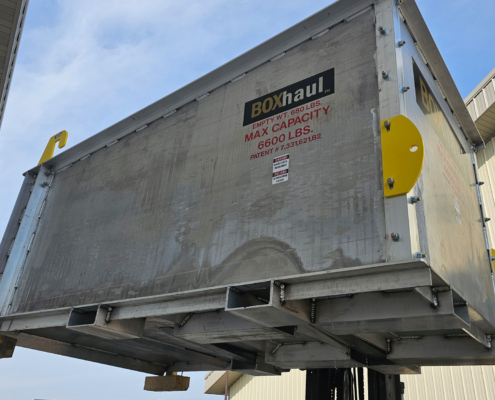
The BOXhaul dump box was built around the lift, not adapted to it. It self-dumps when lifted by a crane or tipped with an extended-reach fork truck, with no hydraulics or mechanical release to maintain, and it’s rated to carry up to 6,600 pounds without overloading the crane handling it. Because there’s nothing mechanical to fail mid-lift, crews get a hopper that behaves the same way on the fiftieth cycle as it did on the first.

What to Verify Before You Attach a Hopper to Your Crane

A crane hopper is only as good as the specs behind it, so a few checks before you commit save headaches later.

Payload Rating and Crane Capacity

Confirm the hopper’s rated payload against your crane’s lift capacity at the radius you’ll actually be working, not just its maximum rated load. A hopper rated for 6,600 pounds doesn’t help if your crane can’t safely swing that weight at the distance debris needs to travel between floors and grade.

Connection Type and Compatibility

Check that the lifting points are built for your crane type, tower, mobile, or overhead, before you order. A hopper with adaptable fittings across crane types gives you flexibility if equipment changes mid-project, which matters more on longer builds where the crane on site in month one isn’t always the crane on site in month six.

Work With a Crane Hopper Built for the Lift, Not Adapted to It

A crane hopper only pays off if the attachment holds up to the way it’s actually used: lifted, tipped, and cycled floor after floor without a mechanical part to babysit. Get that part right and vertical debris removal stops being a bottleneck between structural phases.

BOXhaul builds its self-dumping hopper specifically for crane use, with reinforced lift points, a 6,600-pound payload rating, and zero hydraulics to maintain across tower, mobile, and overhead crane setups. Reach out to talk through which configuration fits your next multi-story build.

Share This Post

  • Share on Facebook
  • Share on X
  • Share on WhatsApp
  • Share on Pinterest
  • Share on LinkedIn
  • Share on Tumblr
  • Share on Vk
  • Share on Reddit
  • Share by Mail

More Like This

Categories

  • Attachments
  • Boxhaul
  • Construction Dump Boxes
  • Construction Logistics
  • Construction Waste Management
  • Debris Dump Box
  • Demolition Dump Boxes
  • Dump Box Safety
  • Equipment Maintenance
  • Equipment Use
  • Industries
  • Material Handling
  • Roofing
  • Safety
  • Self Dumper Boxes
  • Site Operations
  • Uncategorized

Contact Us

"*" indicates required fields

This field is for validation purposes and should be left unchanged.

About Us

BOXhaul’s one-of-a-kind dump boxes are revolutionizing how commercial construction gets done.

What We Do

The BOXhaul Dump Box

BOXhaul Accessories 

Industries We Serve

About Us

Contact Us

9363 67th Street NW, Annandale, MN 55302

(612) 702-5392

sales@boxhaul.com

Website by Abstrakt Marketing Group ©
  • Privacy Policy
  • Sitemap
  • Linkedin
  • Facebook
Scroll to top Scroll to top Scroll to top

This site uses cookies. By continuing to browse the site, you are agreeing to our use of cookies.

AcceptLearn more

Cookie and Privacy Settings


How we use cookies

We may request cookies to be set on your device. We use cookies to let us know when you visit our websites, how you interact with us, to enrich your user experience, and to customize your relationship with our website.

Click on the different category headings to find out more. You can also change some of your preferences. Note that blocking some types of cookies may impact your experience on our websites and the services we are able to offer.

Essential Website Cookies

These cookies are strictly necessary to provide you with services available through our website and to use some of its features.

Because these cookies are strictly necessary to deliver the website, refusing them will have impact how our site functions. You always can block or delete cookies by changing your browser settings and force blocking all cookies on this website. But this will always prompt you to accept/refuse cookies when revisiting our site.

We fully respect if you want to refuse cookies but to avoid asking you again and again kindly allow us to store a cookie for that. You are free to opt out any time or opt in for other cookies to get a better experience. If you refuse cookies we will remove all set cookies in our domain.

We provide you with a list of stored cookies on your computer in our domain so you can check what we stored. Due to security reasons we are not able to show or modify cookies from other domains. You can check these in your browser security settings.

Other external services

We also use different external services like Google Webfonts, Google Maps, and external Video providers. Since these providers may collect personal data like your IP address we allow you to block them here. Please be aware that this might heavily reduce the functionality and appearance of our site. Changes will take effect once you reload the page.

Google Webfont Settings:

Google Map Settings:

Google reCaptcha Settings:

Vimeo and Youtube video embeds:

Accept settingsHide notification only