
BOXhaul
  • BOXhaul Dump Box
    • Specifications
  • Accessories
    • Cart
    • Chain Door
    • Hinge Pin Door
    • Fork Pockets
    • Mesh Cover
    • Replacement Parts
  • Industries
    • Construction
    • Roofing
    • Demolition
    • Crane Rental
  • About
    • Partners
    • Areas We Serve
    • Careers
    • Blog
    • Specifications
  • Contact Us
  • Menu Menu

A Commercial Contractor’s Guide to Hopper Containers

Before a project kicks off, there’s a version of this conversation happening in field offices and site trailers: which containers actually handle the volume, the material weight, and the equipment on site? Hopper containers are central to that question for commercial crews managing demolition waste, roofing debris, and construction scrap. Getting the match right starts with understanding what types exist, which specs matter most, and how each container fits the equipment and site conditions you’re working with.

What Is a Hopper Container?

A hopper container is an open-top collection unit purpose-built to work with lifting equipment on commercial job sites. Unlike general-purpose bins, these containers are designed around a specific lift method and a defined dump mechanism.

How It Works on a Job Site

A hopper container collects debris or material at the point of work, gets moved by lifting equipment when full, and empties either manually or through a self-dumping mechanism. Structured lifting attachments and a specific dump design are what separate a hopper container from a standard collection bin or open-top box. On active commercial sites, the efficiency of that collection-to-disposal cycle directly affects how long cleanup takes, how many crew members get pulled off productive work, and how quickly the site transitions to the next phase.

How Hoppers Differ From Roll-Offs and Open-Top Bins

Roll-off dumpsters are stationary and swapped out by truck. Hopper containers are built to move with the work, repositioning across the site as debris accumulates in different areas. That mobility, combined with the ability to dump at the point of disposal rather than waiting on a truck schedule, is the core operational advantage for fast-moving commercial crews.

The open-top design of most construction hoppers also allows fast, open-sided loading. The full range of dump hopper configurations spans crane-only, forklift-only, and dual-compatible designs, each suited to different site conditions and lifting equipment.

Types of Hopper Containers Used on Commercial Sites

Hopper containers aren’t a single product category. The right type depends on the lifting equipment available on your site and whether material movement is primarily vertical or horizontal.

Crane Hoppers

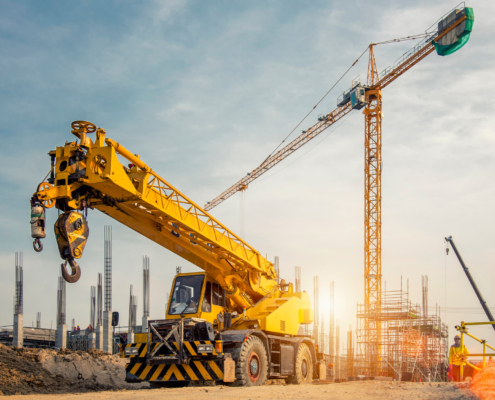
A crane hopper is designed to be lifted and transported by a crane, typically via chains or slings attached to lifting loops on the container. These containers are essential on multi-story construction, high-rise demolition, and roofing projects where material needs to travel vertically between floors or from roof level to ground.

Crane hoppers are rated for specific below-the-hook lifting standards and need to match the crane’s rated capacity and reach. The self-dumping mechanism on commercial crane hoppers activates when the container is lifted and tipped at the dump zone, emptying it without a manual unloading step.

Forklift Hopper Containers

Forklift hoppers are built for ground-level material handling where horizontal movement is the priority. Fork pockets built into the base of the container accept a standard forklift’s tines, letting the operator pick up, move, and reposition the container across the site without coordinating a separate crane operation.

Commercial renovation jobs, ground-floor demolition, and warehouse operations use this configuration because it integrates with equipment already on site. One forklift operator handles positioning and disposal from start to finish.

The Self-Dumping Mechanism and Why It Matters

Self-dumping is the design feature that separates commercial-grade hopper containers from standard collection bins. It’s also the single factor with the most direct impact on crew time and site pace.

How Self-Dumping Works

A self dumping hopper uses a gravity-driven mechanism to empty its contents when lifted and tipped. There’s no hydraulic system, no manual latch, and no crew required at the dump point. The container tips and empties on its own, and the operator can return it to working position for the next load cycle. On fast-moving commercial sites, that speed lets the disposal cycle run continuously without stopping production to deal with manual unloading.

What It Removes From the Workflow

Before self-dumping containers became standard on commercial sites, crews manually shoveled or transferred material out of collection bins at the disposal point. That step added labor time, added physical risk when handling heavy or sharp debris, and created a bottleneck at the end of every full load.

A hopper container with a self-dumping design removes that step entirely. The lift-and-tip action handles the dump, the crew stays at the work zone, and the cycle closes in seconds. Over the course of a full shift, that time compounds.

The right hopper container makes the difference between a cleanup cycle that costs crew time and one that runs on its own. BOXhaul’s self-dumping dump boxes are built for commercial sites that can’t afford the delays that come with manual handling.

Explore the BOXhaul Dump Box

Specs That Actually Matter Before You Buy a Hopper Container

Comparing containers on spec sheets looks simple. The details that separate a workable match from an ideal one interact with your specific equipment, site conditions, and material volume.

Capacity, Payload Weight, and Container Tare Weight

Rated capacity tells you the maximum volume or weight the container holds. The container’s tare weight matters just as much. A heavy box reduces how much actual debris payload you can move before hitting your lifting equipment’s rated limit, narrowing usable capacity before a single piece of debris goes in.

BOXhaul’s dump boxes use aluminum construction to keep tare weight low while maintaining a payload rating up to 6,600 pounds. That balance preserves usable lift capacity for the material you’re moving rather than burning it on the container itself.

Lifting Compatibility, Door Configuration, and Dump Mechanism

A hopper container has to physically match the lifting equipment on your site. Crane hoppers need correctly sized lifting loops and rated chains. Forklift units need fork pockets spaced to match your equipment’s tine width. Getting this wrong means the container doesn’t integrate cleanly, and every shift shows you where the friction is.

Door configuration affects workflow across the full load cycle: chain doors contain loose debris during transport, hinge pin doors allow wide-open access for oversized material, and mesh covers prevent windborne debris on open sites. The dump mechanism itself should be gravity-driven with no hydraulic parts, which eliminates field maintenance and removes the most common point of failure.

Matching the Right Hopper Container to Your Site

Getting the right container for your project comes down to three variables: the equipment you’re running, the material you’re moving, and how the site is laid out.

Equipment on Hand and Site Layout

The most important starting point is the lifting equipment already on site. If you’re running a crane, a crane hopper is the natural fit. If the site operates on forklifts without overhead lift capability, a forklift-compatible container is the right choice. Sites running both can configure equipment to handle each lift type as the project phase demands.

Commercial construction sites that span multiple phases benefit from containers configurable for both crane and forklift use, so the same unit works as the project evolves and equipment needs shift.

Material Type and Volume

Heavy demolition debris, roofing waste, and light commercial materials interact differently with container size and dump mechanism. Dense materials like concrete and masonry hit payload limits quickly, so a smaller container that cycles fast often outperforms a larger one running at partial load.

High-volume jobs where debris accumulates rapidly benefit most from a self-dumping design. The faster the container empties and returns to service, the fewer load cycles get lost to handling time at the end of each fill.

The Hopper Container Setup That Keeps Commercial Sites Moving

Choosing a hopper container isn’t just about finding something that holds debris. The right one matches your lifting equipment, handles your material type without hitting payload limits early, empties fast without crew intervention, and holds up to field conditions across multiple jobs. On commercial sites where crew time and job pace both carry a direct cost, those details determine whether your debris handling setup helps the crew or slows it down.

BOXhaul builds self-dumping hopper containers for commercial contractors who need a setup that keeps pace with the work. Lightweight aluminum construction, gravity-driven self-dumping, compatibility with both crane and forklift operations, and configurable accessories add up to a container built for the demands of commercial sites rather than general-purpose use. If you’re evaluating hopper container options for an upcoming project, reach out to talk through what the right configuration looks like for your crew.

Share This Post

  • Share on Facebook
  • Share on X
  • Share on WhatsApp
  • Share on Pinterest
  • Share on LinkedIn
  • Share on Tumblr
  • Share on Vk
  • Share on Reddit
  • Share by Mail

More Like This

Mobile Crane on a road and tower crane in construction site

How Crane Hoppers Work on Multi-Story Commercial Sites

Equipment Use
https://boxhaul.com/wp-content/uploads/2024/04/Mobile-Crane-on-a-road-and-tower-crane-in-construction-site.jpg 1250 2000 Abstrakt Marketing /wp-content/uploads/2023/10/BOXhaul_Logo.png Abstrakt Marketing2026-09-15 07:56:252026-09-15 07:56:31How Crane Hoppers Work on Multi-Story Commercial Sites

Categories

  • Attachments
  • Boxhaul
  • Construction Dump Boxes
  • Construction Logistics
  • Construction Waste Management
  • Debris Dump Box
  • Demolition Dump Boxes
  • Dump Box Safety
  • Equipment Maintenance
  • Equipment Use
  • Industries
  • Material Handling
  • Roofing
  • Safety
  • Self Dumper Boxes
  • Site Operations
  • Uncategorized

Contact Us

"*" indicates required fields

This field is for validation purposes and should be left unchanged.

About Us

BOXhaul’s one-of-a-kind dump boxes are revolutionizing how commercial construction gets done.

What We Do

The BOXhaul Dump Box

BOXhaul Accessories 

Industries We Serve

About Us

Contact Us

9363 67th Street NW, Annandale, MN 55302

(612) 702-5392

sales@boxhaul.com

Website by Abstrakt Marketing Group ©
  • Privacy Policy
  • Sitemap
  • Linkedin
  • Facebook
Scroll to top Scroll to top Scroll to top

This site uses cookies. By continuing to browse the site, you are agreeing to our use of cookies.

AcceptLearn more

Cookie and Privacy Settings


How we use cookies

We may request cookies to be set on your device. We use cookies to let us know when you visit our websites, how you interact with us, to enrich your user experience, and to customize your relationship with our website.

Click on the different category headings to find out more. You can also change some of your preferences. Note that blocking some types of cookies may impact your experience on our websites and the services we are able to offer.

Essential Website Cookies

These cookies are strictly necessary to provide you with services available through our website and to use some of its features.

Because these cookies are strictly necessary to deliver the website, refusing them will have impact how our site functions. You always can block or delete cookies by changing your browser settings and force blocking all cookies on this website. But this will always prompt you to accept/refuse cookies when revisiting our site.

We fully respect if you want to refuse cookies but to avoid asking you again and again kindly allow us to store a cookie for that. You are free to opt out any time or opt in for other cookies to get a better experience. If you refuse cookies we will remove all set cookies in our domain.

We provide you with a list of stored cookies on your computer in our domain so you can check what we stored. Due to security reasons we are not able to show or modify cookies from other domains. You can check these in your browser security settings.

Other external services

We also use different external services like Google Webfonts, Google Maps, and external Video providers. Since these providers may collect personal data like your IP address we allow you to block them here. Please be aware that this might heavily reduce the functionality and appearance of our site. Changes will take effect once you reload the page.

Google Webfont Settings:

Google Map Settings:

Google reCaptcha Settings:

Vimeo and Youtube video embeds:

Accept settingsHide notification only